24 self-guided modules built on exposure and response prevention (ERP). Practise changing the checking, asking, replaying and cancelling that keep OCD going, one small step at a time.
Written by an OCD and ERP clinician. Five introductions free to read. One payment, no subscription.
Six of the 20 statements from Find Where to Start. None of them ask what your thoughts are about.
Tick one or two statements and three modules appear here.
Open the full finder, with all 20 statements.
You checked the stove. Then you checked your memory of checking the stove. Then you went back.
You’ve asked the same question so many times you’ve started asking it in different words, to different people.
A thought showed up that horrified you, and you’ve spent the whole day trying to prove it doesn’t mean anything.
You replay conversations to make sure you didn’t say something wrong.
You have a word, a prayer, a number or an image that you use to cancel a bad thought, and it never stays cancelled.
You’ve stopped going places, touching things or doing things you used to enjoy, and you’ve called it “being careful”.
Every answer helps for a moment. Then the doubt comes back, often louder, and you go round again. Checking, asking, reviewing and cancelling all bring a few minutes of relief, and that relief teaches your brain to do it again next time.
ERP works the other way. You practise letting the doubt be there while you do something different, and your brain learns, gradually, that it doesn’t have to be settled first. That’s what every module in STG OCD Skills helps you practise.
Not a promise that the thoughts will stop. A way to spend far less of your life responding to them.
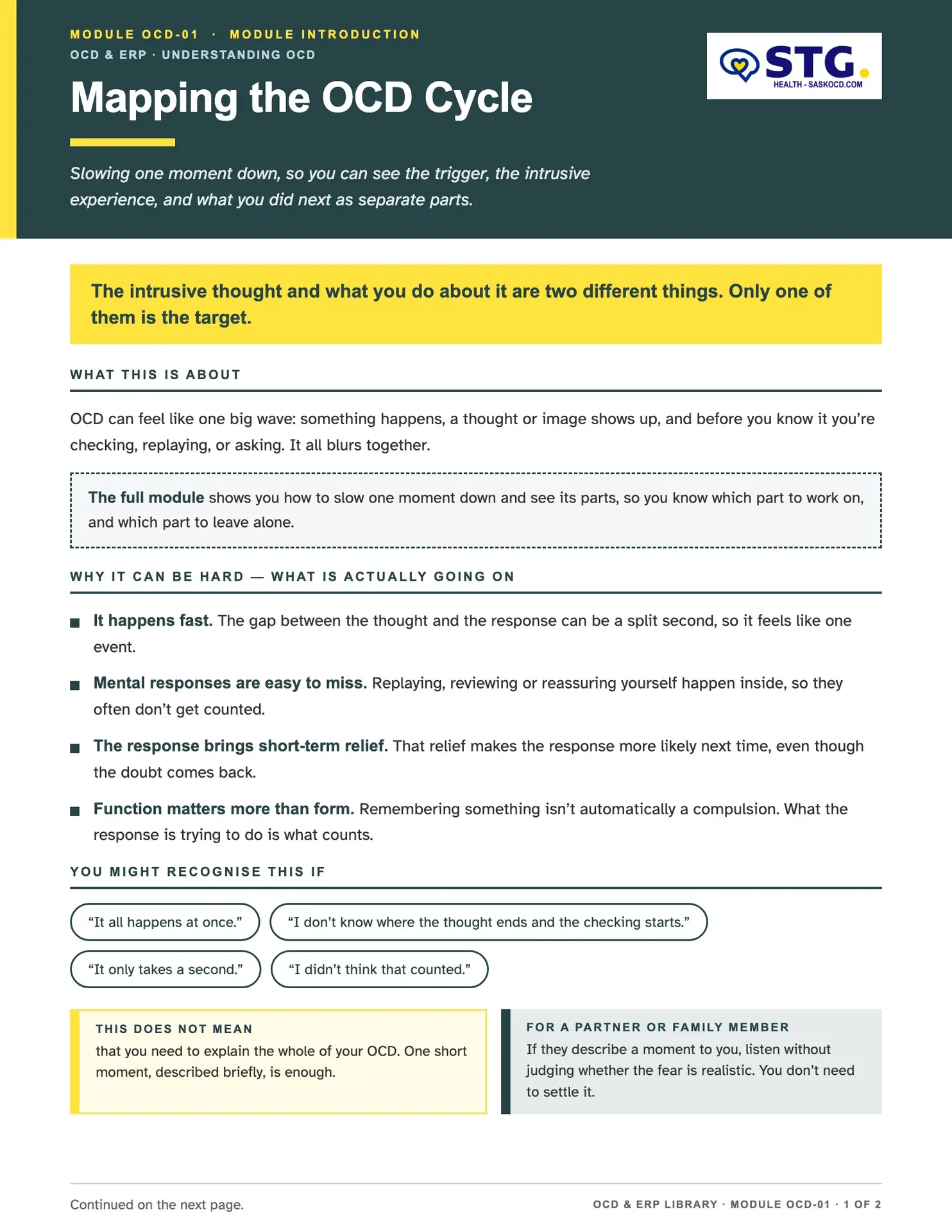
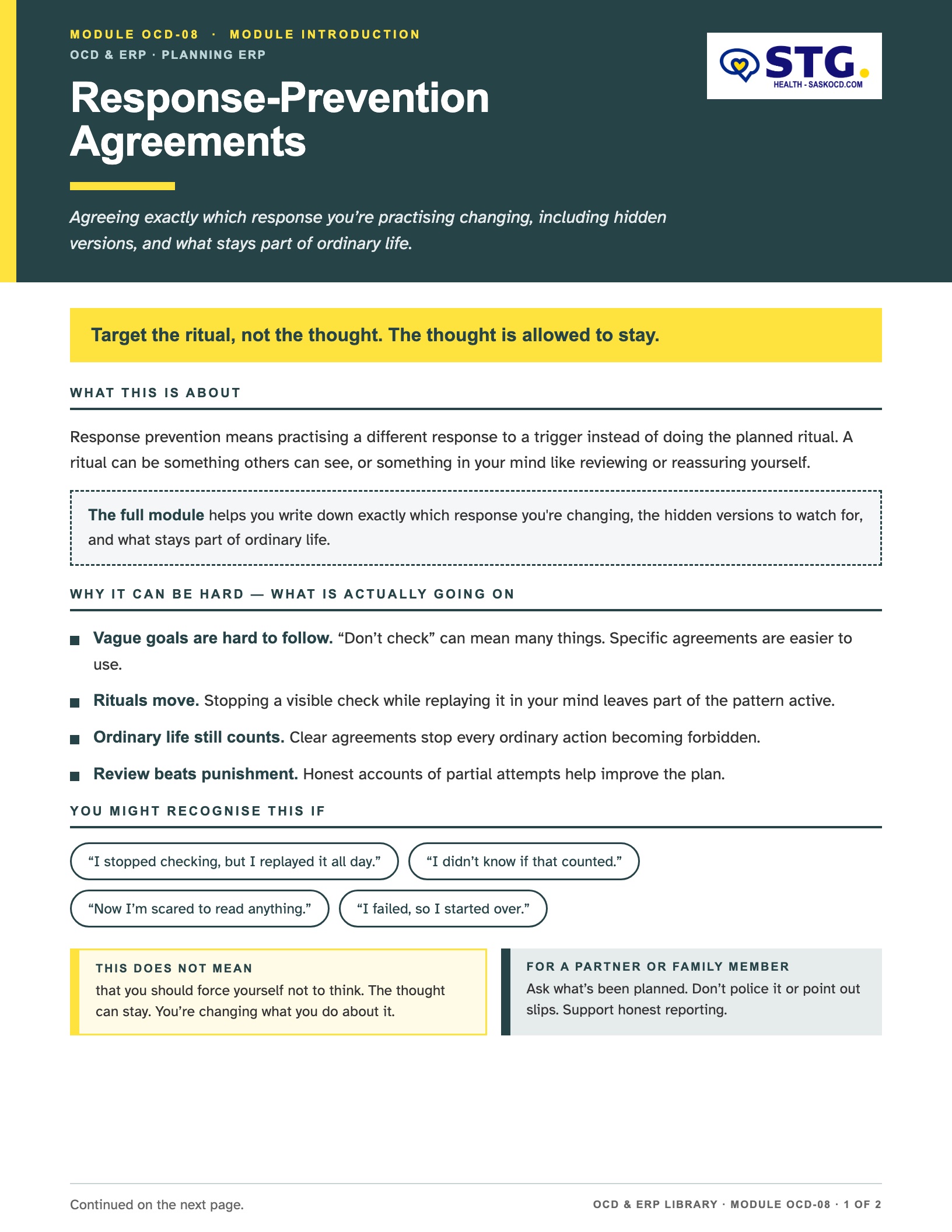
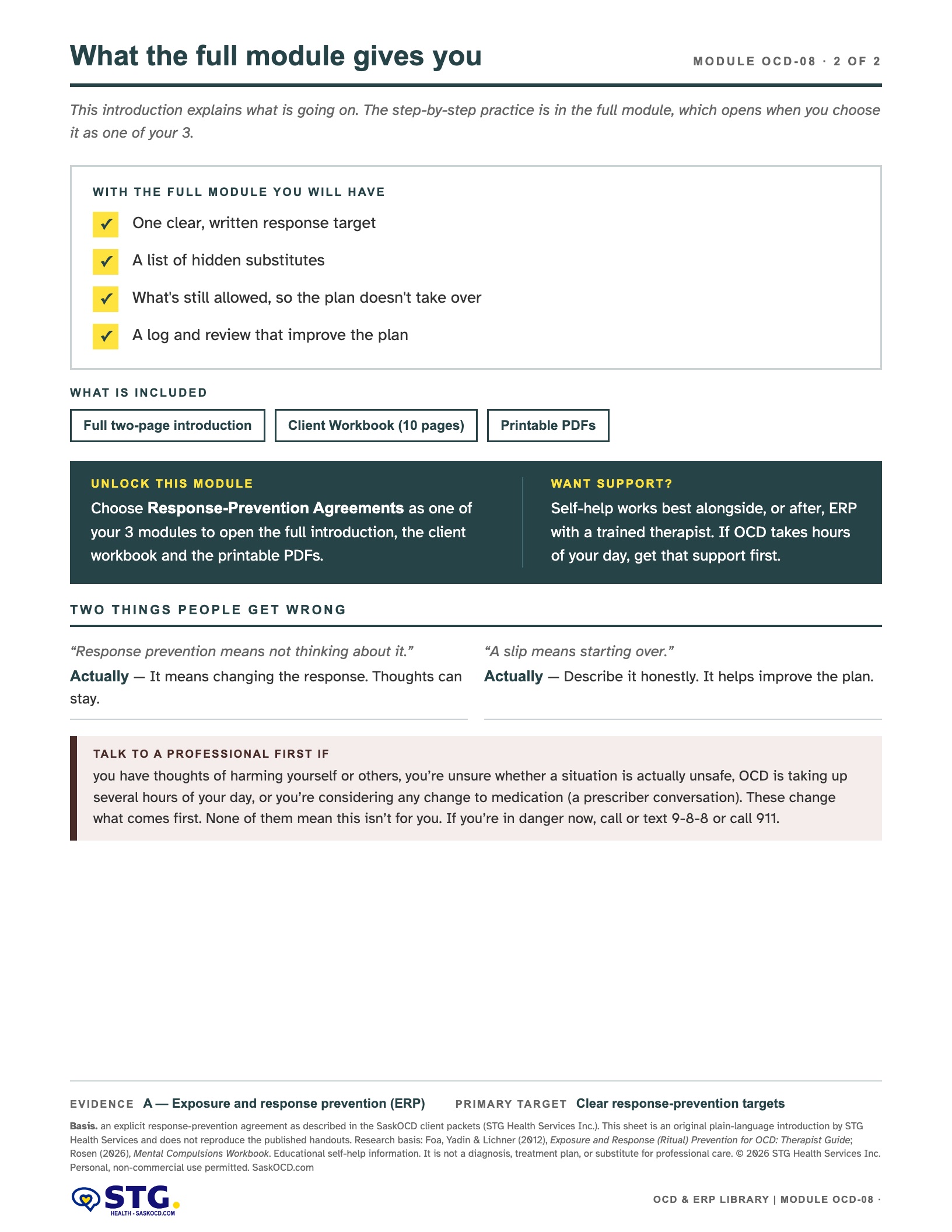
Every module has a two-page introduction that explains what’s really going on, plus a 10-page workbook that walks you through the practice: planning, a simple record of what happened, and a weekly review. Read it on screen, print it or download the PDF.
Tick the statements that sound like you and get the three modules written for those patterns. It never asks what your thoughts are about.
Choose what the urge wants you to do, pick a delay of one to fifteen minutes, and let the urge be there while a timer runs. No reassurance and no arguing with the doubt, with a private log of how it goes. Checking and asking urges are free; every other kind comes with your purchase.
One module in every area is free to read. The other introductions open when you buy, with the workbooks for the three you choose.
Seeing the pattern for what it is.
Facing things, one planned step at a time.
The rituals that happen inside your head.
Living with uncertainty, and with what matters.
Keeping it going when it gets hard.
For anyone who’s tried “just don’t check” and found it didn’t hold. “Try not to worry” is too vague to follow, and rituals have a way of moving somewhere less visible: you stop going back to check, and start replaying it in your head instead. This module is about being clear on exactly which response you’re changing, while the thought is allowed to stay.
Every one of the 24 modules is built this way: the why, the practice, the review.
Answer a few quick questions or browse by what you’re dealing with. You get three suggestions, not a list of 24.
The two-page introduction explains why this pattern is so sticky, in plain language, and why the way out is practising a different response, not finding the perfect answer.
The workbook walks you through one small, specific practice, starting with a mild example, not your hardest one.
A short record, a weekly review and one adjustment. A partial attempt is useful information, not failure.
There are no streaks to keep and no scores to protect, and nothing asks you to describe your thoughts.
No diagnosis needed. Self-help works best for mild to moderate OCD, or alongside ERP with a trained therapist. If you start and it feels like too much, that’s a reason to get support, not a sign you’ve failed.

Dr. Chris de Feijter, EdD, MACP, CCCCanadian Certified Counsellor and DBT clinician
“After 20 years in schools and my work as a therapist with adults, I know how long people wait for OCD help, and how much they can do in the meantime. These modules are the ERP steps I wish everyone could start on day one.”
Dr. Chris de Feijter
Every module comes from the SaskOCD OCD and ERP Library that our clinicians at STG Health Services use with adults. STG is a telehealth psychotherapy practice based in La Ronge, Saskatchewan, with locations in Prince Albert and Regina.
We rewrote the modules so you can use them on your own, because ERP-trained therapists are hard to find, waitlists are long, and a lot of people would rather start by themselves. The library is led by Dr. Chris de Feijter, who spent 20 years as a special education and inclusion consultant before working in psychotherapy.
Prefer to work with a therapist? STG also offers regular psychotherapy for OCD, including ERP, through saskocd.com, and the modules you choose here work alongside it.
ERP is the best-studied psychological treatment for OCD. Each module draws on published ERP and acceptance-based approaches and shows its sources and evidence grade on the sheet. Where research is still thin, the sheet says so.
None of the tools ask what your thoughts are about, none of them offer reassurance, and every workbook tells you what to do if the workbook itself starts to feel like something you have to get exactly right.
Read five introductions and use the tools before you spend anything.
C$0
C$39one time
Add a 75-minute phone consultation with an STG clinician. You work through your three modules together, plan your first practice steps and leave with a personal action plan. After you pay, you pick a weekday time on the booking page, and a clinician or intake coordinator confirms it.
C$225
Something else on your mind? Write to [email protected].
No. If the patterns on this page sound like yours, the modules were written for you. They don’t diagnose OCD, and they don’t replace an assessment if you want one.
It’s self-guided practice built on ERP principles. Working with an ERP-trained therapist is still the gold standard, especially for harder steps. The modules work well on their own for mild to moderate OCD, and alongside therapy for anyone.
No, and that’s on purpose. Reassurance feels good for a moment and keeps the doubt coming back. The modules help you practise living with the uncertainty instead of settling it.
No. Every workbook starts with a mild, recent example, never your hardest one, and keeps ordinary safety and medical precautions in place. Imaginal practice for distressing themes is something we recommend doing with an ERP-trained therapist.
Yes. These are common OCD themes, and the modules work on the pattern, not the content. None of the tools ask what your thoughts are about.
No. These are self-help tools you use on your own. They come from the modules our clinicians use in therapy at STG Health Services, and they also work well alongside a therapist. If you’d like regular psychotherapy, including ERP, STG offers that too, through saskocd.com.
No. Every decision about medication stays with your prescriber.
We keep your account and payment details. Your Find Where to Start answers aren’t saved, and your Urge Delay log stays on your own device.
Read the five free introductions and try the free part of Urge Delay first, to see whether the approach fits you. After you buy, you can read all 24 introductions before choosing your three. If a practice doesn’t go as planned, its workbook shows you how to adjust it instead of giving up. And if OCD is taking over your days, that’s a sign to add a therapist, not a sign you’ve failed.
Yes. You can add a 75-minute phone consultation for C$225, at checkout or after you’ve chosen your modules. An STG clinician helps you fit your three modules to your week and plan your first practice steps, and you get a personal action plan afterwards. After you pay, you pick a weekday time on the booking page, and a clinician or intake coordinator confirms it.
Start with Find Where to Start. It suggests three modules for the patterns you recognise. After you buy, all 24 introductions open up, so you can take those three or read around and pick your own.
No. Choices are final, so read the introduction before you choose. Each one shows what the module is for and what the practice involves.
You don’t need to fix all of it. You need one small practice that holds, and then the next one. It takes two minutes to find yours.